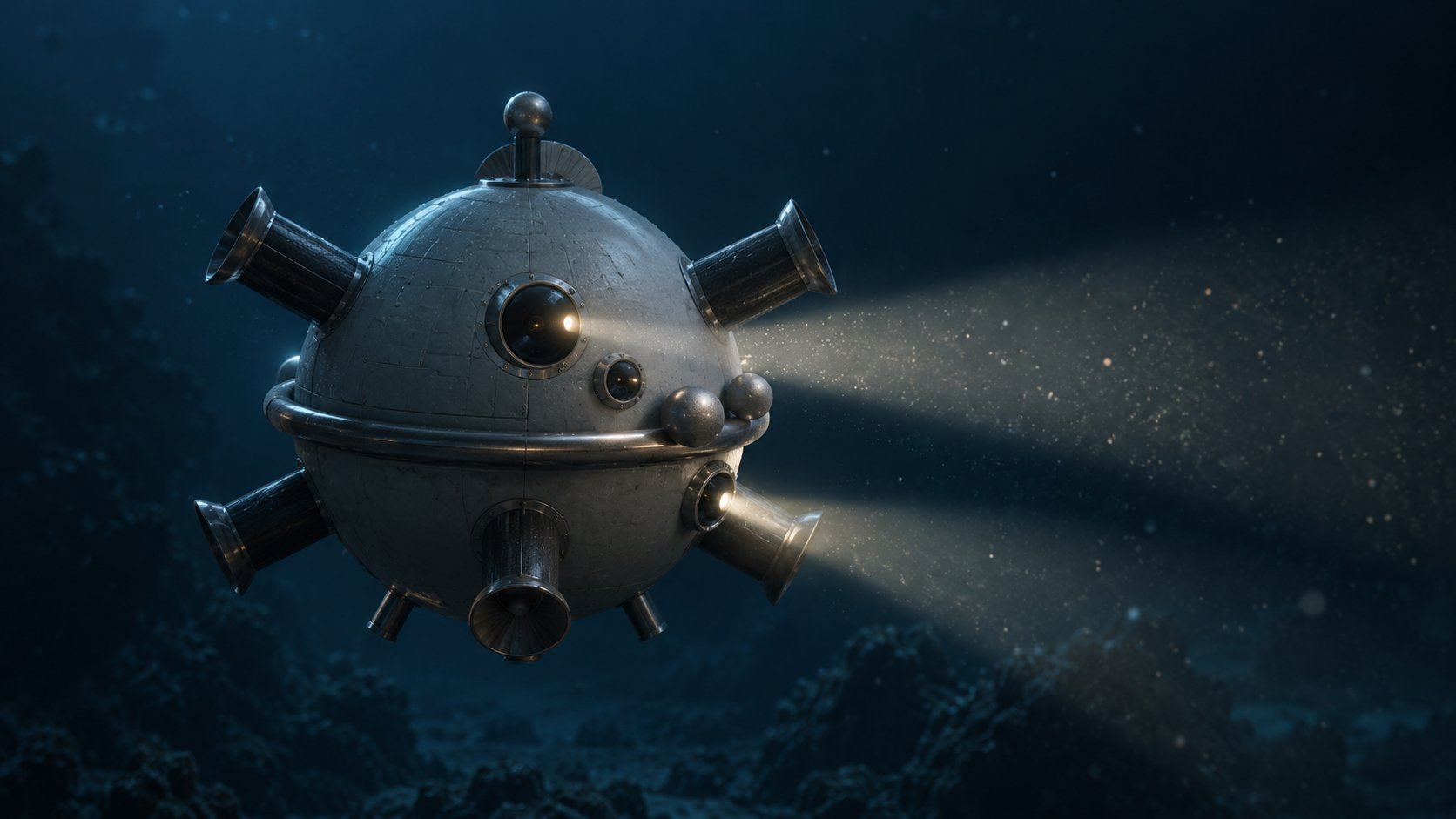
Thalor Tech is building autonomous underwater systems to explore, monitor, and protect the least understood part of our planet — at scales, depths, and durations that human crews cannot sustain.
Not just robots. Infrastructure. The platforms, software, and sensing architectures needed to give humanity persistent, scalable awareness of the world beneath the surface.
The ocean covers the majority of our planet. It regulates the climate, sustains biodiversity, carries global trade, and holds the cables and pipelines that connect the modern world. It is also the domain we understand least — and the one we are most poorly equipped to monitor at scale.
The barriers are real and formidable: extreme pressure at depth, near-total darkness, communications that cannot use radio waves, and the sheer scale of the environment. Getting there requires expensive vessels, specialist crews, and favorable weather. Staying there has been almost impossible.
The result is that the ocean — which regulates our climate, stores enormous quantities of carbon, sustains much of Earth's biodiversity, and carries the cables and pipelines that run the modern world — is observed only in brief, expensive snapshots. We do not have persistent eyes beneath the surface. And the cost of that ignorance is growing.
Critical infrastructure goes uninspected. Reef degradation is detected late. Pollution maps are incomplete. Security gaps in harbor and coastal environments persist. Scientific models run on data that is years old and geographically sparse.
The problem is not that we don't care. It's that we haven't had the tools. Thalor is building them.
Light attenuates within meters. Optical sensing requires active illumination or alternative modalities beyond shallow depths.
Each 10m adds ~1 atmosphere. Engineering electronics and structures for depth demands significant investment and iterative testing.
Radio cannot penetrate seawater. Acoustic links carry the weight — limited in bandwidth, affected by multipath and noise.
Research vessels and piloted submersibles are irreplaceable but costly, weather-dependent, and unable to maintain persistent coverage.
Monitoring is episodic. Large portions of the ocean go entirely unobserved between surveys, leaving enormous gaps in scientific and operational understanding.
Human presence disturbs marine habitats. Monitoring platforms must minimize acoustic and physical impact to operate responsibly at scale.
Thousands of kilometers of subsea cables and pipelines carry data and energy globally. Inspection at scale has no adequate solution today.
Ports, harbors, and coastal infrastructure require persistent underwater awareness. Current gaps represent meaningful risks for owners and operators.
Three initial concept designs — each optimized for a distinct operational profile, sharing a common design philosophy: compact, modular, and deployable without a dedicated support vessel.
A compact, torpedo-form autonomous vehicle optimized for efficient survey, bathymetric mapping, and environmental data collection. Deployable from small vessels. Designed for range and sensor coverage over large areas.
A loitering platform built for persistent observation. Lower speed, higher endurance. Suitable for harbor security, pipeline inspection, and long-duration environmental monitoring stations.
A smaller, lower-cost unit purpose-built for coordinated fleet operation — dividing search areas, relaying data between nodes, and maintaining mission continuity when individual units fail or are recovered.
Early concept drawings that define the design direction: fewer moving parts, modular sensing, compact manufacturing, and fast iteration.
Instead of relying on a single expensive vehicle, Thalor's swarm architecture is built around distributed intelligence — small systems that coordinate, divide search areas, relay data, and continue operating even when individual units fail.
If one unit fails, the mission continues. The swarm adapts and redistributes coverage automatically — no single point of failure.
Multiple units working in parallel can survey areas that would take weeks with a single vehicle, completed in hours.
Many smaller units can be more cost-effective than one large platform. Lower cost per data point across large-area missions.
Nodes relay acoustic data through the formation, extending effective communication range beyond what any single unit could achieve.
Swarms replan dynamically — converging on detected anomalies while other units maintain patrol patterns. Intelligence at the fleet level.
Units hand off coverage as battery levels decline — enabling continuous monitoring over indefinite time horizons.
The ocean regulates climate, stores carbon, sustains biodiversity, and supports the lives of billions. Yet vast portions go entirely unobserved — not because we don't care, but because we haven't had the tools.
Reef systems are the ocean's most biodiverse and most threatened environments. Autonomous systems can monitor bleaching events, biodiversity shifts, and recovery at scales and frequencies impossible for divers.
Temperature, salinity, and chemistry gradients are critical inputs to climate models. Dense, continuous measurement networks simply do not yet exist at the scale the science demands.
The distribution of plastics and chemical pollutants in ocean water columns is poorly characterized. Persistent autonomous sensing can begin to build the maps that remediation and policy need.
A significant fraction of the ocean floor remains less accurately mapped than the surface of Mars. Compact AUVs can fill this gap mission by mission, at a fraction of traditional survey costs.
Monitoring compliance and ecological health across protected areas requires persistent presence. Autonomous systems provide the continuous visibility that stewardship and enforcement need.
After hurricanes, vessel incidents, or pipeline failures, rapid underwater assessment is critical. Autonomous systems characterize damage faster and at lower risk than crewed alternatives.
"Thalor Tech exists because the future of the planet depends on better visibility into the systems that sustain it. The ocean is not a peripheral concern. It is the foundation."
Hardware alone is not enough. Thalor is building the complete stack — from autonomy software and mission planning to data ingestion, fleet coordination, and operator dashboards. The vehicle is the first layer. The platform is what scales.
Sensor payloads designed to swap between missions. Acoustic, optical, chemical, and current sensors — without rebuilding the vehicle.
Define waypoints, search patterns, survey grids, and loitering zones. Pre-mission simulation validates paths before any unit enters the water.
Onboard autonomy handles navigation, obstacle response, station-keeping, and adaptive replanning — without continuous operator input.
Architecture designed around the realities of underwater communication. Data is prioritized, compressed, and queued for efficient transmission through acoustic links.
Orchestrate multi-vehicle missions from a single interface. Assign roles, track positions, manage battery states, and monitor data streams across a swarm.
Sensor data tagged, timestamped, and geolocated before ingestion. Mission data flows into analysis pipelines for visualization, export, and downstream processing.
All autonomy and mission planning software is validated in high-fidelity simulation before any water testing — accelerating iteration and reducing risk at every phase.
A phased, disciplined path from design through prototype, controlled testing, field pilots, and swarm trials.
Thalor Tech is actively seeking partnerships across maritime operations, scientific research, infrastructure inspection, climate monitoring, and public-sector engagement. If you see the same gap we see — reach out.